


The Monday Morning Reality in Field Service
It’s 7:45 AM. The phone is already ringing.
A technician is running late. A customer needs an emergency visit. Another job needs to be rescheduled.
At the same time, dozens of customers are due for their annual inspection follow-up.
Most of them will not be contacted this week.
Not because they’re not important, but because urgent work always takes priority over planned work.
This is a structural issue in many service businesses.
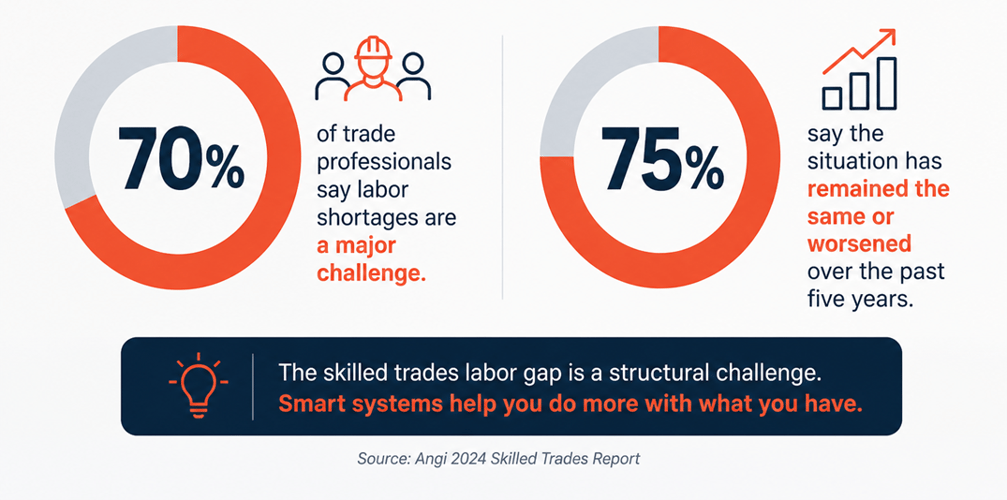
According to the Angi 2024 Skilled Trades Report, 70% of trade professionals say labor shortages are a major challenge, and 75% report that the situation has remained the same or worsened over the past five years.
The implication is clear:
👉 Increasing headcount alone is unlikely to solve the problem (Read more on this topic)
👉 Operational efficiency is becoming a primary lever for growth
Emergency Work vs Recurring Work: A Structural Imbalance
Not All Revenue Behaves the Same
Emergency service work is essential. It keeps customers satisfied in urgent situations and often represents a visible part of the business. However, it is also inherently unpredictable. Scheduling is constantly changing, margins fluctuate depending on urgency and travel, and the work does not compound over time.
Recurring inspections and maintenance operate very differently. They can be planned, follow standardized procedures, and are generally easier to execute efficiently. Over time, they create a stable base of repeatable revenue.
Many contractors recognize that recurring work is valuable, yet relatively few have systems in place that allow them to fully capture and manage it. As a result, a large portion of that opportunity remains underutilized.
The Cost of Missed Follow-Ups
A pattern that appears consistently across service businesses is not related to poor service, but to a lack of follow-up.
A customer receives an inspection or installation. The experience is satisfactory. Time passes, and the next service cycle approaches. No structured follow-up is triggered, and no one reaches out. When the need arises again, the customer simply contacts another provider.
This type of loss is rarely visible because it does not generate a complaint. It simply disappears.
Even conservative assumptions show the impact:
- 150 recurring clients
- 15–20% not re-engaged annually
This represents:
👉 20–30 lost service opportunities per year
At $250–$400 per inspection, this equates to:
👉 $5,000–$12,000 in annual revenue leakage
Importantly, this loss is rarely visible in financial reports.
The Administrative Constraint Behind the Problem
To understand why this happens, it is necessary to look at the daily reality of office operations.
Dispatchers and administrative staff manage a constant flow of urgent tasks. Incoming calls, technician scheduling, last-minute changes, invoicing, and payment follow-up all compete for attention. In that environment, recurring maintenance work is always important, but rarely urgent.
Because of this, it is consistently postponed.
This creates a gap between what should happen and what actually happens. It is not a reflection of team performance. It is a structural limitation of how the work is organized.
Labor Shortage as a Structural Constraint
Labor shortages in the trades are not a short-term fluctuation. They are driven by long-term factors such as demographic shifts, retirements, and the pace at which new workers enter the field.
Across North America, data shows that experienced tradespeople are leaving the workforce faster than they are being replaced. At the same time, demand for services continues to grow.
This creates a persistent imbalance that cannot easily be corrected through hiring alone.
Even in situations where additional technicians can be recruited, the impact is limited if administrative processes remain unchanged. More technicians generate more jobs, but also more scheduling complexity, more follow-ups, and more invoicing. Without improved systems, the result is often increased pressure rather than increased efficiency.
What Changes When Work Is Structured Differently
Some service businesses have begun to address this constraint by changing how recurring work is managed.
Instead of relying on manual coordination, they introduce structured workflows that operate consistently regardless of daily workload. Follow-ups are triggered automatically based on service dates. Customers receive timely communication without requiring someone to remember to send it. Appointment booking happens through shared calendars rather than multiple phone calls. Reminders are sent systematically, and administrative steps such as invoicing and documentation follow predefined processes.
In this model, the system handles predictable tasks, and people focus on exceptions.
The difference is not technological complexity. It is consistency.
The Often Overlooked Compliance Dimension
In many sectors, recurring inspections are not optional. In plumbing, HVAC, fire protection, and similar industries, inspections are often tied to regulatory requirements.
When inspections are missed, the consequence is not only lost revenue. It can also expose customers to compliance risk and potential liability.
A structured approach to recurring service ensures that inspection cycles are tracked, reminders are sent, and documentation is maintained. This creates value not only for the contractor but also for the client.
Where Prowise Fits in Practice
Most service businesses already have what they need to generate recurring work. Customer lists exist, often in Excel or in a CRM. Service histories are known. The challenge is not access to information, but the consistent execution of follow-ups over time.
Prowise Recurring Maintenance Flow is designed to bridge that gap.
Instead of requiring a complex implementation, the starting point is simple. Existing client data can be imported directly, and from there, the system applies a structured logic to what would otherwise be manual tasks. There is no need for a dedicated IT resource or a lengthy onboarding process. The goal is to move from a static list of clients to an active, managed workflow.
In practical terms, this changes how several recurring activities are handled. Tasks that typically rely on memory or availability become systematic. Follow-up emails are sent at the right time without requiring someone to initiate them. Appointment scheduling no longer depends on multiple exchanges, as clients can select available time slots directly. Reminders are delivered consistently, reducing missed appointments. Invoicing is triggered as part of the process rather than being delayed, and compliance-related tracking is maintained without relying on separate tools or spreadsheets.
Tasks Prowise Recurring Maintenance Flow Manage Automatically and Intelligently
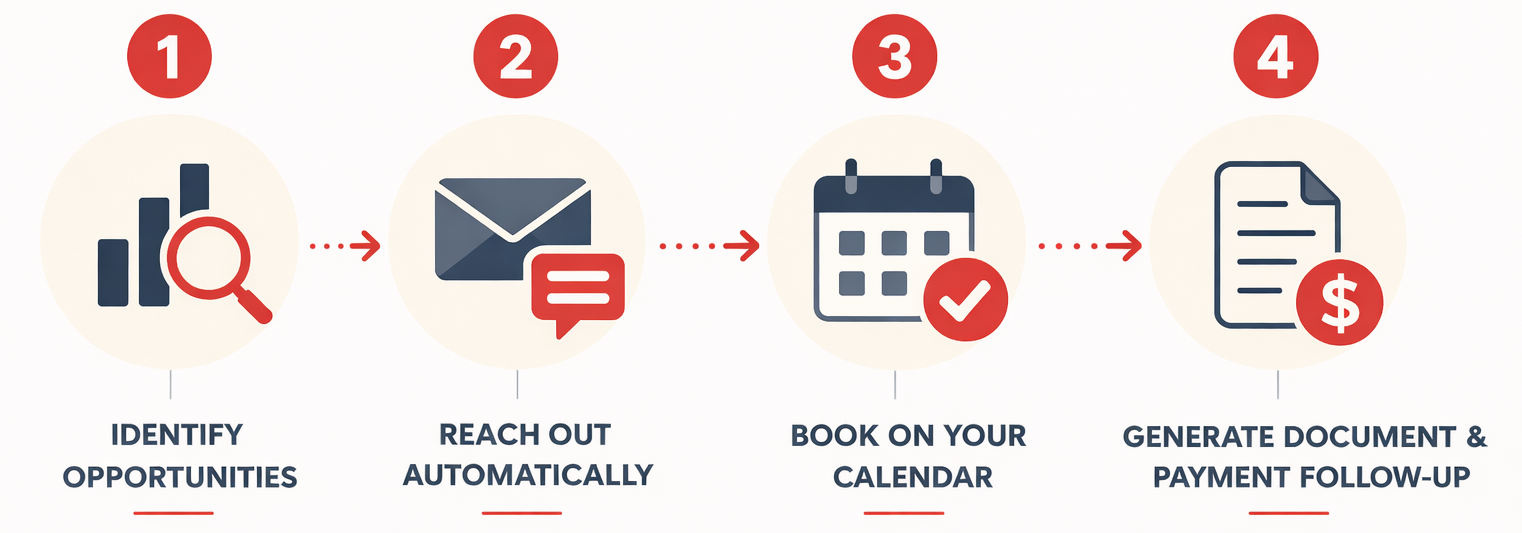
Individually, these steps are familiar. What changes is their reliability.
To understand the impact, it is useful to return to a typical Monday morning.
The same business begins its day, but the starting point is different. Follow-ups have already been sent automatically based on service dates. Several clients have responded and booked appointments directly into the calendar. Reminders are already scheduled. In some cases, invoices have been issued or even paid.
None of this required manual intervention at the moment it happened.
The role of the team does not disappear, but it shifts. Instead of initiating each step, they oversee a process that is already in motion and intervene where needed.
This is not about adding complexity. It is about ensuring that predictable work is handled predictably.
A Different Monday Morning
If we return to the earlier scenario, the difference becomes visible.
The same business starts the day, but instead of facing a backlog of tasks that must be initiated manually, a portion of the work has already been handled. Follow-ups have been sent, appointments have been scheduled, reminders are in place, and some invoices may already be processed.
This does not eliminate the need for human involvement, but it removes the burden of managing predictable activities.
Addressing Common Concerns
Contractors often question whether automated communication will be effective, particularly if they are accustomed to phone-based interactions. In practice, many customers, especially property managers and business clients, are comfortable with email communication when it is clear and relevant. Automation serves as a starting point, not a replacement for human contact.
There is also concern about the communication feeling impersonal. With the use of customer specific data such as name, location, and service history, automated messages can remain highly contextual and appropriate.
For those already using CRM or scheduling tools, automation does not compete with these systems. It complements them by ensuring that actions occur at the right time without requiring manual initiation.
Even for smaller businesses, the impact can be meaningful. A modest base of recurring clients represents a significant portion of predictable revenue, and small improvements in retention and scheduling consistency can have measurable financial effects.
From Reactive Operations to Predictable Growth
The difference between reactive and structured operations extends beyond efficiency. It affects the long-term trajectory of the business.
A company that relies heavily on urgent work must continuously generate demand and manage variability. A company with a strong base of recurring revenue operates with greater stability, is easier to scale, and is less dependent on constant firefighting.
Over time, this difference becomes more pronounced.
The Cost of Maintaining the Status Quo
Delaying the implementation of structured systems does not maintain the current state. It allows inefficiencies to accumulate.
Missed follow-ups continue. Clients are lost quietly. Administrative pressure remains high. Opportunities that could be captured are simply not realized.
At the same time, the external environment is not becoming easier. Labor constraints persist, and expectations for responsiveness and service quality continue to rise.
👉Read the blog : The Trade Service Industry is Changing. What it means for your business
Conclusion
Labor shortages in the trades are a structural reality. Attempting to resolve them through hiring alone addresses only part of the problem.
The more effective approach is to rethink how work is organized, particularly for recurring activities that can be standardized and automated.
Businesses that adopt this approach position themselves to operate more efficiently with the resources they already have, while those that do not will continue to face increasing operational pressure.
See how Prowise fits into your current workflow.
Book a 20-minute demo to walk through your specific situation.